When people imagine the postwar South, they often picture front porches, sweet tea, and lazy summer afternoons. But for my grandfather, who grew up in Lumberton, North Carolina, “things weren’t quite as pretty as you think.”
In a town of about 10,000 people, daily life in the late 1940s and early 1950s was both close-knit and complex. “It was very easy to get around,” he remembers. “I could get around town very easily on my bicycle, and I had a lot of friends. Everybody knew each other because it was such a small town.” His graduating class had only about 80 people, half from town and half from the surrounding farmland. They jokingly called it Lumberville, a playful jab at the town’s small size, but the truth was clear: “Life was good. I enjoyed being there,” he said simply.
Raised by his mother, a schoolteacher, after his father died young, money was always tight. “We were rather limited financially since Mother was a teacher,” he said, but childhood still brought joyful memories: Scouts, friends, river adventures. “We took boating trips down the Lumber River to the ocean,” he recalled. “It was a really, really nice childhood.”
Work, even at a young age, was expected. But his experience with tobacco—the South’s iconic crop—wasn’t what most assume. “I didn’t actually work in the tobacco fields,” he explained. “What I did was work for the county agriculture department to measure people’s tobacco fields.” Using long tape measures, he helped regulate how much farmers planted, ensuring they didn’t exceed government quotas that kept prices stable.
Later, he took on a job in the bustling tobacco warehouses. “That involved taking the tobacco from farmers when they brought it in trucks and arranging it in piles by the approximate quality,” he said. Some piles weighed up to 200 pounds, waiting for auction buyers to inspect and bid. Eventually, photography called to him, and he left the warehouses behind to become a newspaper photographer—a shift he welcomed.
Despite the town’s friendly surface, Lumberton was sharply divided by race. “The movie theaters had three entrances,” my grandfather said. “The whites sat on the ground floor, and the Blacks and the Indians sat upstairs with a partition down the middle.” Even basic necessities were segregated. “The water fountains were labeled White, Indian, and then Black on the lower level,” he remembered. This everyday segregation was simply part of life then—visible, normalized, and rarely questioned, even by those who would later look back with regret.
Politics in the South also looked dramatically different than it does today. “Most of the South was Democrat,” he explained. “Although they were very conservative Democrats, usually called Southern Democrats.” Republicans were so rare that they seemed almost alien. He laughed remembering a scene from childhood: “I remember walking down the street with my mother. She punched me and said, ‘There goes Mr. Sellers across the street. He’s a Republican.’ I looked to see what sort of creature this was—maybe he had horns!”
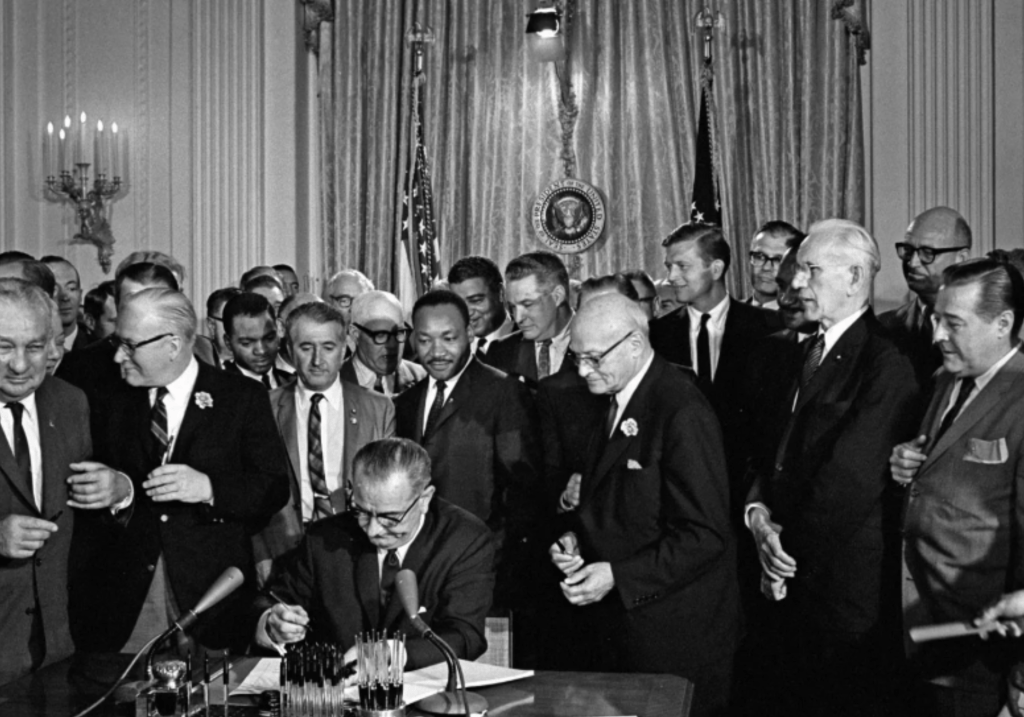
That landscape began to shift dramatically after the Civil Rights Act of 1964. “After that, things began to change rapidly,” he said. Disillusioned by the Democratic Party’s support for civil rights, many white Southerners, including in places like Lumberton, began voting Republican—a trend that continues today.
One change my grandfather notes with particular interest is immigration. “We had none when I was growing up,” he said. “But now they are in many places in the South, doing a lot of the jobs Americans don’t want to do—maintenance work, lawn work.” Today, Hispanic grocery stores, Mexican restaurants, and bilingual signage dot towns like Lumberton, reshaping the cultural landscape he once knew so well.
Though he left Lumberton in 1958 after winning a prestigious Morehead Scholarship, the town remains vivid in his memory—a place filled with both kindness and contradictions. “I’m not sure that’s the thing you wanted to hear,” he said with a chuckle after finishing his story. “But that’s how it was in the late ’40s and ’50s when I was growing up.”
By Izzy Bellehumeur

