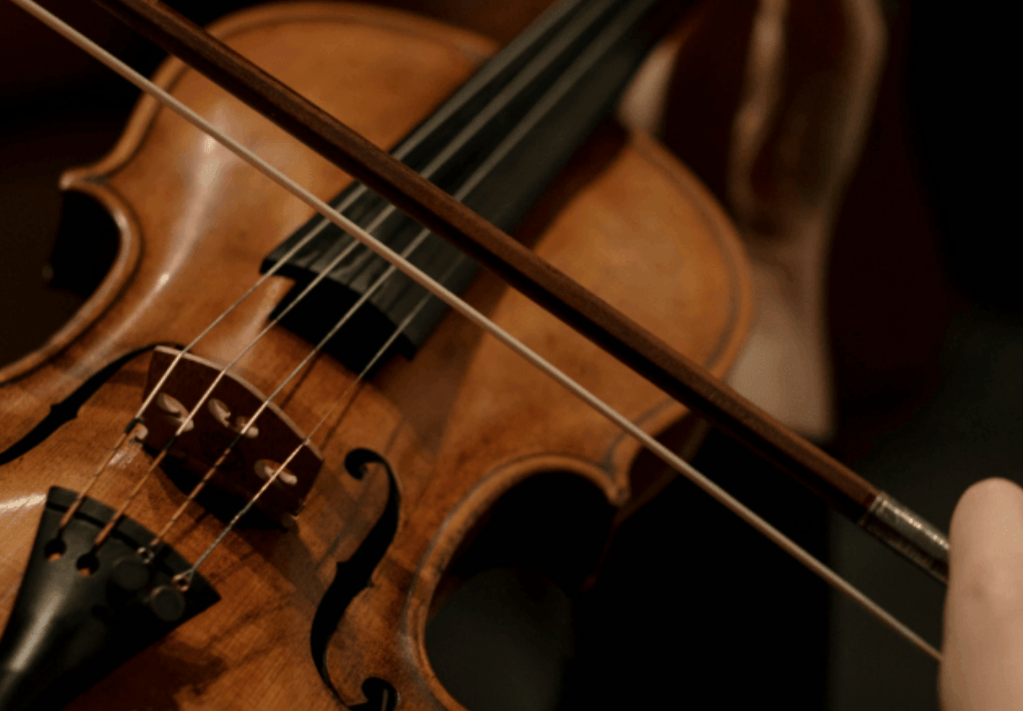
I first fell in love with the violin when I was eleven years old. It wasn’t an instant romance—more like a clumsy friendship that slowly blossomed into something special. My parents, noticing my growing interest, enrolled me in lessons with one of the best-reviewed teachers in our town. They even splurged on a beautiful violin—polished wood, rich honey tones, with strings that shimmered under the light. At the time, I didn’t fully grasp the sacrifice that came with that gift, but I knew it meant something important. That violin became my escape, my outlet, and my quiet way of making sense of the world.
As I improved, I joined a group called Strolling Strings, a youth ensemble in our community that brought together dozens of young musicians every Wednesday afternoon. Our ensemble was unique: we moved with the music we made. The violists, bassists, and cellists formed a stationary pit, while we violinists strolled through the performance space, weaving around tables and playing our memorized setlist. It was challenging, but there was something magical about creating music that traveled—literally.
Every year, we performed at the Brookdale Senior Living Home, one of our most anticipated traditions. To be honest, as an 11-year-old, the idea of performing for elderly residents didn’t quite excite me. I was more focused on not forgetting my parts or bumping into a table. The seniors, quietly sitting in groups of eight around white-clothed tables, felt like an unfamiliar audience—so far removed from the world I knew.
But something shifted during my first performance there. We were midway through Farandole, a lively and fast-paced piece that always made my fingers ache, when I felt a pair of eyes watching me closely. As I finished the final note and turned slightly to move to the next table, I heard a soft voice ask, “Anak?”
I turned toward the speaker. She was a petite elderly woman, her silver hair curled neatly at the sides, and her eyes sparkled behind round glasses. Her skin was a familiar warm shade of brown, and her accent was unmistakably Filipino. In my rural, predominantly white town, it was rare—almost unheard of—for me to encounter someone who shared my heritage. In Tagalog, “anak” means my child. This was a term I’ve only ever heard from my own grandmother. I froze for a moment, caught off guard. I smiled awkwardly, unsure of what to say, and then shuffled away with the rest of the group as we continued to rotate.
But her words stayed with me. “Anak.” It was the first time someone outside my family had connected with me through our shared identity. I wasn’t just another kid playing the violin—I was her granddaughter, even if only for a moment. I had spent much of my childhood surrounded by a mixture of cultures, yet rarely saw my own Filipino identity reflected back at me. Just a few words made me feel seen in a way I hadn’t before.
After the performance, while munching on cookies (another tradition), I couldn’t stop thinking about her. I didn’t even know her name, but she made me feel like I belonged. The next year, when we returned to Brookdale, I searched every table, hoping to find her again. But she wasn’t
there. I never got the chance to talk with her, to say thank you, or to share how much her words meant to me. It was just one moment, but it shaped me profoundly.
Years later, when the COVID-19 pandemic hit, that memory came rushing back. My own grandmother, living in a senior care facility, began calling more frequently. “I feel so lonely,” she would say. “No one visits anymore.” I couldn’t help but think of that woman at Brookdale—and of how many seniors like her must be feeling isolated and forgotten. I knew I had to do something.
That’s when I founded Smiles Across Miles, an initiative aimed at connecting high school students with seniors in care homes through letters, video messages, and virtual visits. It was my way of building a bridge between generations and cultures—of ensuring that no elderly person had to feel invisible or alone. The project grew quickly, fueled by the same compassion I had felt years before.
Looking back, that brief exchange with the elderly Filipino woman planted a seed. It showed me the power of visibility, the impact of cultural connection, and the importance of showing up for people who often go overlooked. It reminded me that music isn’t just about sound—it’s about emotion, identity, and community. And it taught me that even the smallest interactions can leave the biggest marks on our hearts.
In her, I saw the grandmother I had always loved. In me, she saw the granddaughter she missed. And from that one moment, I discovered a deeper calling: to make others feel as seen as she made me feel.
By Princess Abary

