While growing up in North Carolina during the mid-20th century, my grandfather saw a version of the American South that feels worlds apart from today. His experience, which was shaped by government-regulated agriculture, racial segregation, and drastic economic shifts, can give us a window into how intergenerational memory can help us understand regional change. Through combining his personal story with research, I want to help trace the evolving landscape of the South.
In high school, my grandfather had a job with the county agriculture department. After World War II, the U.S. government had implemented policies to stabilize the price of tobacco by limiting overproduction. “I measured the fields and plotted them on maps,” he told me. “They didn’t want people planting too much, because then prices would drop and everybody would be poor.” He used long tape measures to record the acreage of individual plots and ensure that the farmers didn’t exceed the legal limit. These efforts were meant to ensure that farmers adhered to the acreage limits so that tobacco prices wouldn’t collapse, and families wouldn’t be left impoverished.
He also worked in a tobacco warehouse, where he helped sort tobacco into piles. “We arranged it in piles by approximate quality,” he explained. “Some of those piles weighed up to 200 pounds. Then companies would come in and bid on them, like an auction.” This work was hard—hauling, sorting, lifting—all to support one of the South’s most labor-intensive crops.
But the labor wasn’t evenly distributed. “Townspeople owned most of the farms,” he told me. “Tenant farmers”—most often poor, Black, or Native—lived on the land and worked in exchange for half of the profits from the harvest. This exploitative arrangement is representative of the legacy of sharecropping, a system born after the abolition of slavery that kept many Southern families in deep generational poverty. Even in what seemed like ordinary work, inequality could be found everywhere.
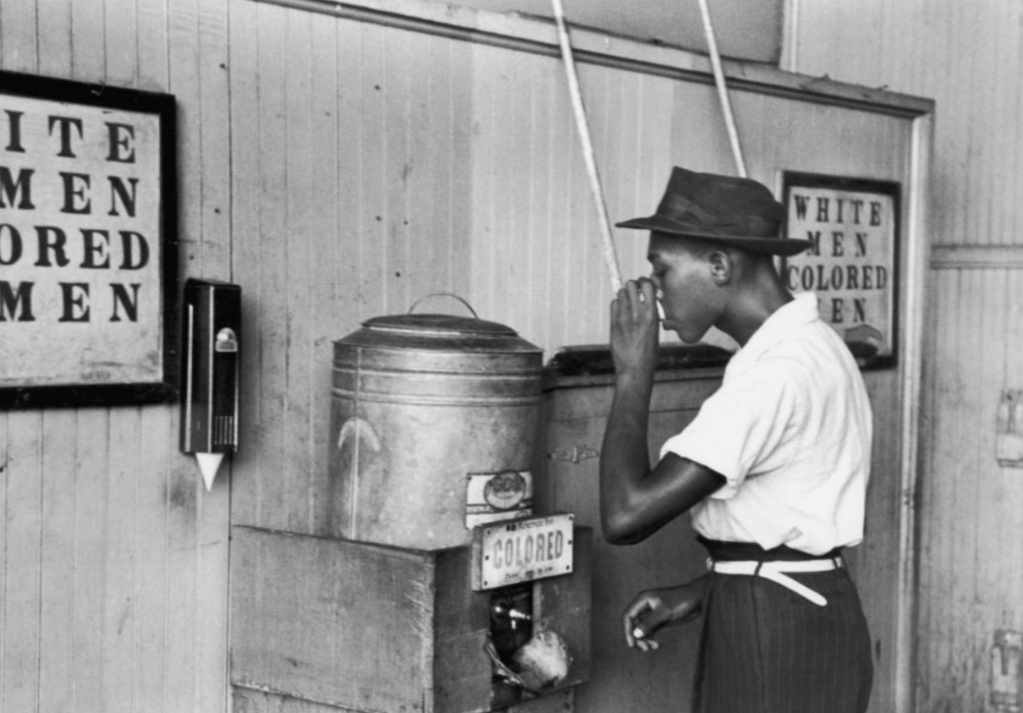
Lumberton, North Carolina, my grandpa’s hometown, was a deeply segregated town. “The movie theaters had three entrances,” he said. “Whites sat downstairs, and Blacks and Indians sat upstairs, separated by partitions.” Water fountains were labeled by race. However, today, the town has changed dramatically. Native Americans (primarily members of the Lumbee tribe) now make up around 40% of the population, and because of that, they’ve gained more influence in local politics and leadership. “They sort of control the town now,” he told me. According to the Journal of Southern History, demographic shifts, urbanization, and increased political participation by marginalized groups have significantly altered the region’s identity. The South is no longer filled with just white landowners and segregated systems.
The first thing my grandfather said to me when he wrote back was, “I’m afraid things weren’t quite as pretty as you think.” That stood out to me. When he speaks, there is no romanticizing or bitterness—just memory. Through these memories, we can see that the South is not just a region, but a living thing, shaped by generations of people who worked, endured, and adapted. His story doesn’t just tell us what the South was, but helps us understand how it became what it is today.
By Izzy Bellehumeur

